







Choosing the right mobile app development company in Egypt is not only about comparing prices. This article helps business owners, founders, and managers evaluate technical capability, business thinking, delivery process, support quality, and long-term reliability before starting a mobile app project.
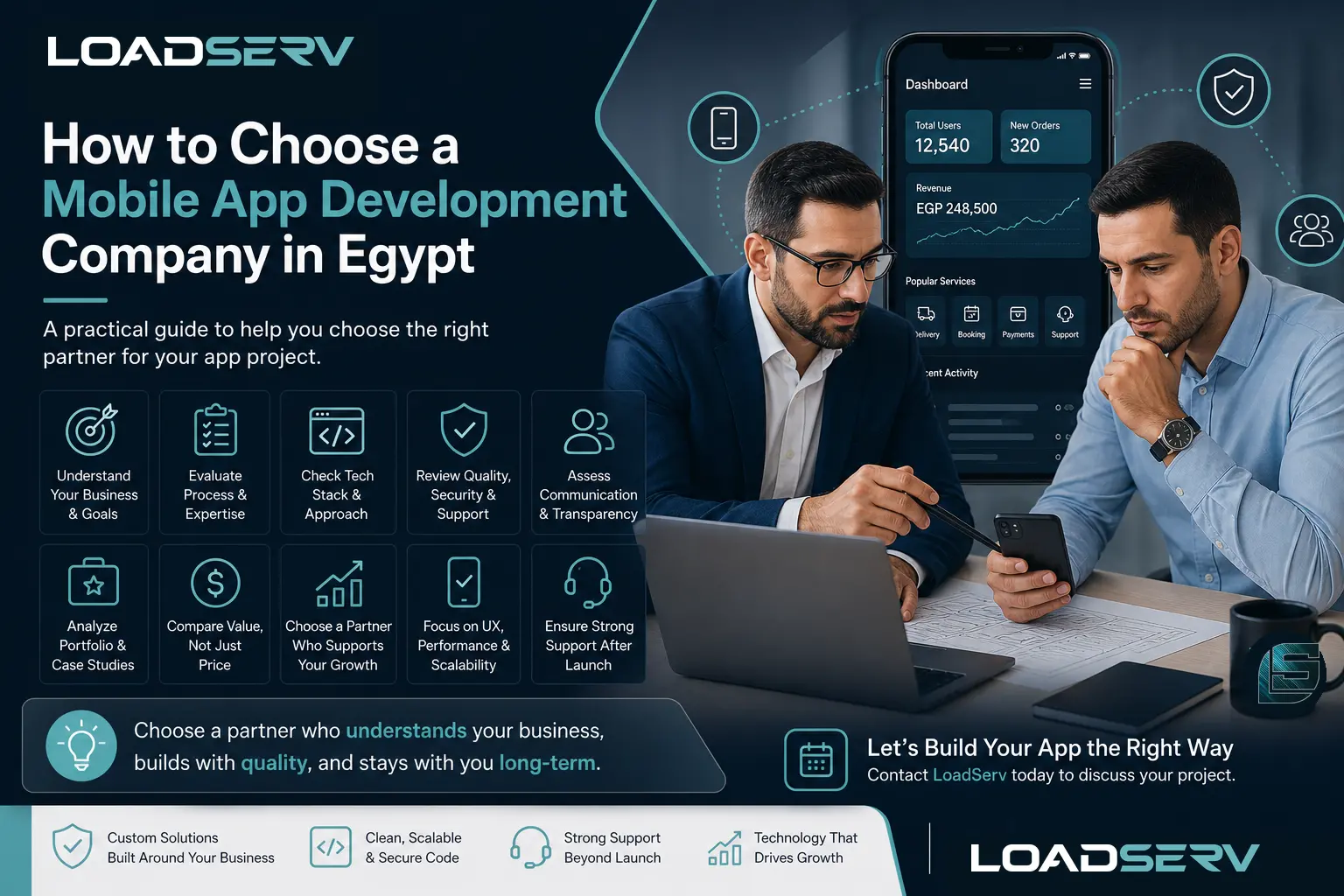
Choosing a mobile app development company in Egypt is not just a technical decision. It is a business decision that can affect your launch, customer experience, operations, brand reputation, and future growth.
Many businesses start by asking: “How much does a mobile app cost?” Cost matters, but it should not be the first question. A mobile app is not just a set of screens. It is a complete digital product that needs planning, architecture, user experience, backend development, testing, deployment, updates, and support.
The better question is: which company can understand the business problem, design the right solution, build it properly, and support it after launch?
This guide will help you evaluate mobile app development companies in Egypt with a clearer and more practical decision-making mindset.
Before comparing companies, clarify what the app is supposed to achieve. Some businesses need a customer-facing app to increase sales, bookings, engagement, or loyalty. Others need an internal app to manage teams, approvals, field operations, deliveries, or reporting.
A professional mobile app development company should not rush directly into screens and features. They should first understand your business model, target users, workflows, revenue logic, operational constraints, and desired outcome.
An e-commerce app, food delivery app, booking app, educational app, healthcare app, marketplace app, and internal business app may all be called “mobile apps,” but they are completely different in structure, risk, backend complexity, user behavior, and support needs.
This is also where a proper MVP strategy matters. A good company should help you define the first reliable version that supports the core user journey without overloading the launch with features that can wait. A strong MVP is not a weak app. It is a focused version built to work properly, launch faster, and give your business room to learn and improve.
If a company gives you a fixed answer before understanding your business properly, that is usually a warning sign.
Technical skill is important, but it is not enough. A mobile app can be technically functional and still fail commercially if the user journey is weak, the business process is unclear, or the launch version is built around the wrong priorities.
The right development partner should help you make better decisions, not just execute requests. They should challenge unclear assumptions, identify missing flows, explain technical risks, recommend a realistic scope, and separate essential features from future enhancements.
This is especially important for founders and business owners in Egypt launching a new digital product. A strong company will help you avoid overbuilding, underbuilding, and spending money on features that do not support your first business goal.
Not every app development company follows the same approach. Some depend heavily on templates, ready-made scripts, low-code builders, or recycled structures. These options may look cheaper at the beginning, but they can become limiting when your business needs custom workflows, integrations, performance optimization, scalability, or long-term ownership.
For very simple cases, ready-made tools may be acceptable. But if your app supports real transactions, customer accounts, payments, dashboards, orders, bookings, marketplace flows, notifications, or business-specific operations, custom development becomes much more important.
A custom-built mobile app gives your business better control over user experience, backend logic, data structure, integrations, security, and future upgrades.
At LoadServ, our mobile app development service is built around custom solutions designed for the actual business case, not generic templates forced into every project.
You do not need to be a technical expert to choose a mobile app development company, but you do need to understand whether the company can explain its technical decisions clearly.
A serious development company should explain whether your app should be built using native development, cross-platform development, or another suitable approach. They should also explain the backend technology, database structure, hosting environment, API architecture, and how the app will be maintained after launch.
For many business apps, cross-platform development using technologies such as Flutter can be a strong option because it allows one codebase to support both iOS and Android while keeping development more efficient. However, the technology should always be selected based on project requirements, not because it is fashionable or convenient.
The key point is not only what technology they use. The key point is whether they can justify the choice in a way that protects your business, budget, timeline, and future scalability.
Price without process is hard to evaluate. Two companies can give different prices for what appears to be the same app, but the difference may be in planning quality, UI/UX depth, backend structure, testing, documentation, deployment support, security, and post-launch responsibility.
Before comparing quotations, ask how the company manages the project from start to finish. A reliable mobile app development process should usually include discovery, requirement analysis, user flow planning, UI/UX design, backend development, mobile development, API integration, quality assurance, deployment, and support.
You should also understand how reviews will happen, how changes will be handled, how progress will be reported, and how acceptance will be measured. If the process is unclear before signing, it will likely become more confusing during execution.
A company’s portfolio can tell you a lot, but only if you review it properly. Do not only look at screenshots. Look at project types, industries served, feature complexity, design quality, business logic, and whether the company has experience with projects close to your needs.
A beautiful interface is important, but it is not the full story. A serious mobile app often includes backend management, user roles, notifications, reporting, payments, content management, and integrations that are not visible from screenshots.
When reviewing a company’s portfolio, ask yourself whether they seem capable of handling the business and technical complexity of your project, not just producing good-looking screens.
Mobile app design is not only about visual style. It is about reducing friction, guiding users, making actions clear, improving conversion, and helping users complete tasks with minimum confusion.
Poor UX can make even a technically strong app fail. If users cannot understand how to register, buy, book, track, request, or manage an action, the app will lose value quickly.
At the same time, the mobile interface is only one part of the product. The backend and admin dashboard are the real engine behind daily operations. Your app may need user management, order management, service management, content control, reports, payments, notifications, permissions, analytics, and operational settings.
A professional company should explain what your team will manage from the admin dashboard and what will require technical intervention. The more operational control your team has, the easier it becomes to run and grow the app after launch.
Testing is not a quick final check before delivery. A serious mobile app must be tested across devices, screen sizes, operating system versions, user scenarios, failed actions, API responses, permissions, and edge cases.
Business owners often discover the real quality of a development company during testing. Weak companies rush this phase or treat reported issues as interruptions. Strong companies expect testing, document issues, fix defects properly, and prepare the app for real usage.
Support after launch is just as important. Once users start interacting with the app, new issues may appear, operating systems may update, business requirements may change, and improvement opportunities may become clear.
Before choosing a company, clarify the bug-fixing warranty, maintenance options, updates, monitoring, emergency response, and how new features will be handled. A company that disappears after launch is not a real technology partner.
The cheapest offer is not always the best offer. In mobile app development, very low pricing often means something important is missing: planning, experienced developers, backend quality, testing, documentation, project management, security, or support.
This does not mean you should automatically choose the most expensive company. It means you should compare what is actually included in the price.
A proper proposal should clarify scope, features, platforms, backend, admin dashboard, design, integrations, timeline, assumptions, exclusions, support, payment terms, and future work boundaries.
If you want to better understand how professional software pricing is usually structured, you can review our pricing approach. It explains why serious software projects should be priced based on real effort, quality requirements, and long-term value rather than random numbers.
Be careful if a company gives a price without understanding the scope, promises unrealistic timelines, avoids detailed discovery, cannot explain its process, refuses to document what is included, or focuses mainly on being cheap.
Other warning signs include weak communication, unclear source code ownership, no testing process, no post-launch support plan, vague technical recommendations, and a portfolio that does not match the type of app you want to build.
These problems may look small before signing, but they can become serious once your money, timeline, and business idea are already committed.
A strong partner should give you clarity before development, structure during execution, and support after launch. They should understand your business model, recommend the right technical direction, define a realistic scope, design a usable experience, build a stable backend, test the product properly, and guide you through deployment.
More importantly, they should be honest about what should be built now, what should wait, what may increase cost, and what may create risk.
The best mobile app development company for your business is not necessarily the one that says “yes” to everything. It is the one that helps you make the right decisions before development becomes expensive.
LoadServ approaches mobile app development as a business and engineering process, not just a design-and-code task. We focus on understanding the purpose of the app, the users it will serve, the workflows it must support, and the operational reality behind it.
Our team builds custom mobile app solutions using reliable technologies, structured backend development, scalable architecture, and practical project planning. We work with businesses that need quality, clarity, and long-term support instead of shortcuts.
Whether you are building a startup product, customer app, marketplace, booking platform, internal business tool, or mobile extension for an existing system, the right starting point is not writing code. The right starting point is understanding what needs to be built and why.
If your idea still needs technical and business validation, our business consulting service can help you define the right direction before committing to full development. If you are ready to start, you can explore our mobile app development service or contact LoadServ to discuss your project.
A mobile app can become a powerful business asset, but only if it is planned, designed, developed, and supported properly. Choosing the wrong company may cost less at the beginning, but it can cost much more later through delays, rebuilds, user complaints, poor performance, and lost opportunities.
The right mobile app development company in Egypt should give you clarity, challenge weak assumptions, build with quality, and support your business beyond launch.
Your app is not just a technical project. It is a business investment. Choose the partner accordingly.



Whether you have a clear app idea or still need technical guidance, LoadServ can help you define the right scope, choose the right approach, and build a custom mobile app designed around your business goals.