







This article helps business owners, founders, and managers in Egypt compare custom mobile app development with ready-made, template-based, and white-label app solutions. It explains the real differences in cost, speed, flexibility, ownership, scalability, integrations, and long-term business value before choosing the right approach.
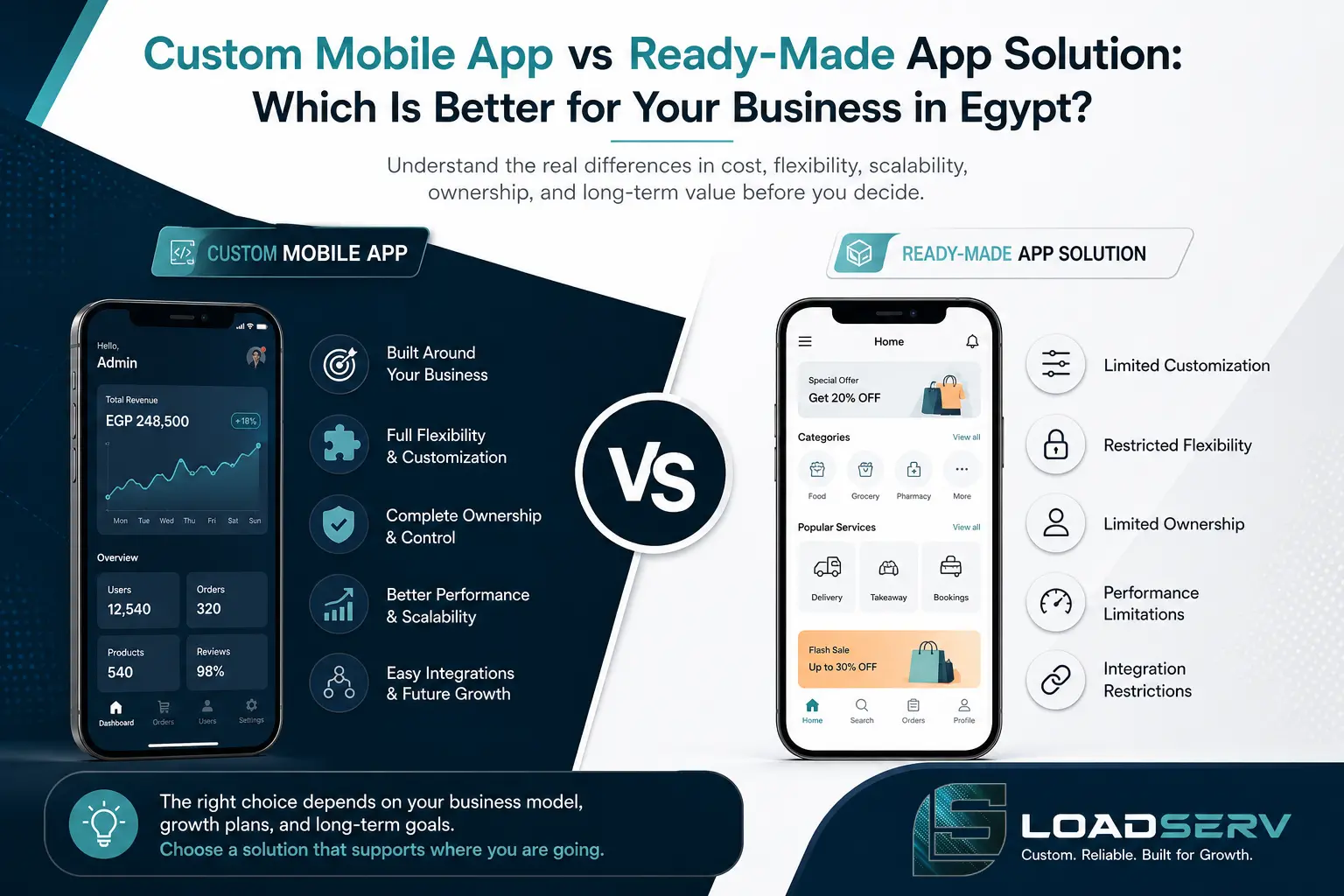
When a business in Egypt decides to build a mobile app, one of the first decisions is not only which company to hire. It is which type of solution to choose: a custom mobile app built around the business, or a ready-made app solution that is already prepared and adjusted to fit the project.
This decision affects more than the launch cost. It affects how much control you have, how easily the app can grow, how well it fits your operations, how integrations will work, how users experience your service, and how much technical freedom your business will have later.
Ready-made solutions are not always wrong. Custom development is not always required from day one. The right answer depends on your business model, your expected growth, the complexity of your operations, and how important the app is to your revenue and customer experience.
This guide compares both approaches from a practical business perspective so you can choose with clarity, not pressure.
A ready-made mobile app solution is a pre-built system that is already developed for a common business model. It may be sold as a template, white-label product, SaaS platform, marketplace script, booking app, delivery app, e-commerce app, or industry-specific app package.
Instead of building the full product from scratch, the provider adjusts branding, colors, content, basic settings, and sometimes limited features to match your business.
This approach can be useful when the business need is simple, the workflows are standard, the budget is limited, and speed is more important than deep customization.
For example, a small business that wants a basic catalog, simple ordering flow, appointment booking, or loyalty app may be able to start with a ready-made solution if it does not need complex logic, unique workflows, advanced integrations, or full technical ownership.
A custom mobile app is planned, designed, and developed around the specific business model, user journey, operational process, and growth direction of the company. It is not forced into a pre-existing structure. The system is built to match how the business actually works.
Custom development usually includes tailored UI/UX design, backend development, admin dashboard, API architecture, database structure, business rules, integrations, security layers, and future scalability planning.
At LoadServ, our mobile app development service focuses on custom-built solutions for businesses that need more than a generic app. We build around the business case, not around a recycled template.
The biggest difference between custom and ready-made apps is business fit.
Ready-made solutions are usually designed around common workflows. This can work well if your business follows the same standard flow the solution was built for. The problem starts when your business needs different user roles, special pricing logic, custom approval steps, unique service rules, special reporting, marketplace behavior, multi-branch operations, or internal workflows that do not match the template.
In that case, your team may end up changing the business to fit the software instead of building software that fits the business.
A custom mobile app gives you more control over how the product works. The user journey, backend logic, admin controls, notifications, permissions, reports, and integrations can be designed around your real operation.
If your app is central to how your business sells, serves, manages, or grows, business fit should matter more than initial convenience.
Ready-made app solutions are usually faster to launch because much of the system already exists. This can be a major advantage if you need to test a simple idea quickly or launch a basic digital presence with limited risk.
Custom app development takes longer because the product needs discovery, planning, UI/UX design, backend development, mobile development, testing, deployment, and support preparation.
However, speed should be evaluated carefully. A fast launch can be useful if the solution truly fits your business. But if the app needs heavy changes, workarounds, or compromises, the time saved at the beginning may turn into delays, technical limitations, or even a rebuild later.
The right question is not “which option is faster?” The better question is: which option gets your business to a usable, reliable, and scalable product faster?
Ready-made solutions usually have a lower starting cost. This is one of their strongest selling points. For early-stage businesses with simple requirements, this can make sense.
Custom mobile apps usually require a higher upfront investment because the work includes strategy, design, development, testing, backend architecture, and project-specific implementation.
But the real comparison should not stop at the first invoice. You need to consider the total cost over time: subscription fees, customization fees, limitations, paid add-ons, dependency on the provider, integration restrictions, performance issues, migration costs, and the possibility of rebuilding later if the business outgrows the solution.
A cheaper app that cannot support your growth may become expensive. A more expensive custom app that gives you control, scalability, and operational fit may create better long-term value.
If you want to understand how serious software projects should be evaluated commercially, you can review our pricing approach. It explains why software cost should be connected to effort, quality, scope, risk, and long-term business value.
Ready-made solutions usually offer limited flexibility. You may be able to change colors, content, categories, basic settings, and some modules, but deeper changes often depend on what the platform allows.
This may not be a problem at the beginning. But as the business grows, you may need custom pricing rules, special user permissions, personalized dashboards, third-party integrations, advanced notifications, loyalty logic, delivery rules, accounting connections, or operational automation.
If the ready-made solution does not support these needs, you either accept the limitation, pay for expensive customization, use manual workarounds, or move to a different system.
Custom development gives your business a clearer path. The app can start with a focused MVP, then evolve through planned phases based on real usage, market feedback, and business priorities.
Ownership is one of the most overlooked differences between custom apps and ready-made solutions.
With many ready-made or white-label systems, you may not fully own the source code, infrastructure, database structure, or core technology. You may be licensing access to a system controlled by the provider.
This can be acceptable if the app is not critical to your business and the provider is reliable. But if the app becomes a major business asset, lack of ownership can become a serious limitation.
Custom development gives your business stronger control over the product, data structure, backend logic, integrations, and future technical direction. The exact ownership terms should always be clearly documented before starting the project.
Before choosing any solution, ask clearly: Who owns the source code? Who controls the hosting? Can we migrate later? Can another technical team maintain it? Can we access our data? What happens if we stop working with the provider?
Ready-made apps are usually designed to serve many businesses with the same structure. This can make them acceptable for standard use cases, but it can also make the experience feel generic or less aligned with your brand and customer behavior.
In many businesses, user experience is not a cosmetic detail. It affects conversion, trust, repeat usage, order completion, booking success, customer support load, and overall satisfaction.
A custom app allows the user journey to be designed around your audience. Registration, onboarding, search, booking, checkout, tracking, notifications, account management, and support flows can be built to reduce friction and increase completion.
Performance also matters. If the app depends on unnecessary features, weak backend structure, or overloaded shared infrastructure, users may experience slow loading, failed actions, or unstable behavior. These problems do not only affect the app. They affect the business behind it.
Many businesses need their mobile app to connect with payment gateways, delivery providers, ERP systems, CRM platforms, accounting systems, inventory tools, maps, SMS gateways, WhatsApp providers, analytics tools, or internal databases.
Ready-made solutions may support some standard integrations. This can be enough if your needs are simple and the supported tools match what you use.
But when integrations become business-specific, custom development is usually stronger. A custom app can be designed with the right API architecture, data flow, error handling, permissions, and operational logic from the beginning.
If integrations are important to your operations, do not treat them as small add-ons. They can affect the entire architecture of the app.
Scalability does not mean building a huge system from day one. It means making technical and structural decisions that do not block growth later.
A ready-made solution may work well for a small number of users, limited orders, simple content, or basic workflows. But as the business grows, you may need more advanced reporting, higher traffic handling, new user roles, more branches, extra services, automation, or deeper management controls.
A custom mobile app can be planned with future growth in mind. The first version can stay focused, while the architecture remains ready for new modules, integrations, markets, languages, and operational expansion.
This is especially important if your app is not just a side channel, but a core part of your business model.
A ready-made solution may be acceptable if your requirements are simple, your budget is limited, your business model is standard, and you need to launch quickly without deep customization.
It can also be useful for early testing when the app is not yet central to your operation, or when you only need a basic digital channel to validate user interest.
In these cases, the main risk is not using a ready-made solution. The risk is expecting it to behave like a fully custom product.
If you choose this path, be clear about its limits from the beginning: what can be customized, what cannot, what you own, what happens if you grow, and how easy it will be to migrate later.
Custom mobile app development is usually the better choice when the app is tied to your business model, revenue, operations, customer experience, or long-term growth.
It becomes especially important if your project includes unique workflows, multiple user roles, payments, bookings, marketplace logic, delivery operations, admin controls, reporting, integrations, security needs, or future expansion plans.
Custom development also makes more sense when you want stronger ownership, better control over the user experience, flexible backend logic, and the ability to keep improving the app based on real business feedback.
If the app is expected to become a serious business asset, custom development is usually not an extra luxury. It is the foundation that protects the product from becoming limited too early.
Choosing custom development does not mean building everything at once. In many cases, the smartest approach is to build a focused custom MVP that includes the essential user journeys, then expand through planned phases.
This gives your business the best of both worlds: a product designed around your real needs, without wasting budget on features that should wait until after launch.
A focused custom MVP can help you launch with quality, test real behavior, improve based on user feedback, and grow without being trapped inside a template-based structure.
If your idea still needs validation, scope definition, or business-technical planning, our business consulting service can help you make the right decision before moving into full development.
LoadServ is a custom-first software company, but we do not believe every business should build a large custom app from day one. The right solution should match the business stage, budget, operational needs, and growth plan.
Our role is to help you understand what should be custom-built, what can be simplified, what should be delayed, and what may create risk if ignored. We approach mobile app development as a business decision first and a technical execution second.
Through our mobile app development service, we design and build custom mobile applications supported by backend systems, admin dashboards, integrations, testing, deployment, and post-launch support. We focus on quality, clarity, and long-term value instead of shortcuts that may create problems later.
You can also explore our portfolio to review examples of our work and understand how we approach digital products across different industries.
The choice between a custom mobile app and a ready-made app solution should not be made emotionally or based only on the lowest starting price.
Ready-made solutions can be useful when the need is simple, the model is standard, and the risks are low. Custom development becomes stronger when the app needs to fit your business, support growth, connect with real operations, and remain under your control.
Your decision should be based on what the app is expected to become. If it is only a basic channel, ready-made may be enough. If it is a serious business asset, custom development gives you the control, flexibility, and long-term foundation your business needs.
If you are comparing both options and want a clear technical and business recommendation, contact LoadServ to discuss your mobile app project before committing to the wrong path.



Share your app idea with LoadServ, and we will help you evaluate whether your business needs a custom mobile app, a phased MVP, or a simpler starting point based on your goals, budget, and growth plan.