







This article helps founders, managers, and business owners in Egypt decide whether their business truly needs a mobile app now, whether a website is enough, or whether they should prepare first before investing in mobile app development.
Many business owners reach a point where they start thinking: “Do we need a mobile app?”
The question is valid. Customers spend a lot of time on mobile devices, competitors may already have apps, and a mobile app can make your business look more advanced and accessible. But that does not mean every business needs an app immediately.
A mobile app can be a powerful business asset when it solves a real problem, improves repeat interaction, supports operations, increases convenience, or creates a better customer experience. But if the business model is not ready, the audience does not need repeated access, or the core digital presence is still weak, building an app too early can waste budget and create unnecessary complexity.
The right decision is not “app or no app.” The right decision is whether a mobile app is the right next step for your business now.
Some businesses want an app because it feels modern. Others want one because a competitor has one. These reasons may create pressure, but they are not enough to justify serious app investment.
A mobile app should have a clear business role. It may help customers order faster, book services more easily, track requests, receive updates, manage accounts, access content, communicate with your team, or use your service repeatedly without friction.
If the app does not improve the customer journey, support revenue, reduce operational pressure, or create a stronger relationship with users, it may not be the right priority yet.
A serious mobile app development decision starts with business logic, not excitement.
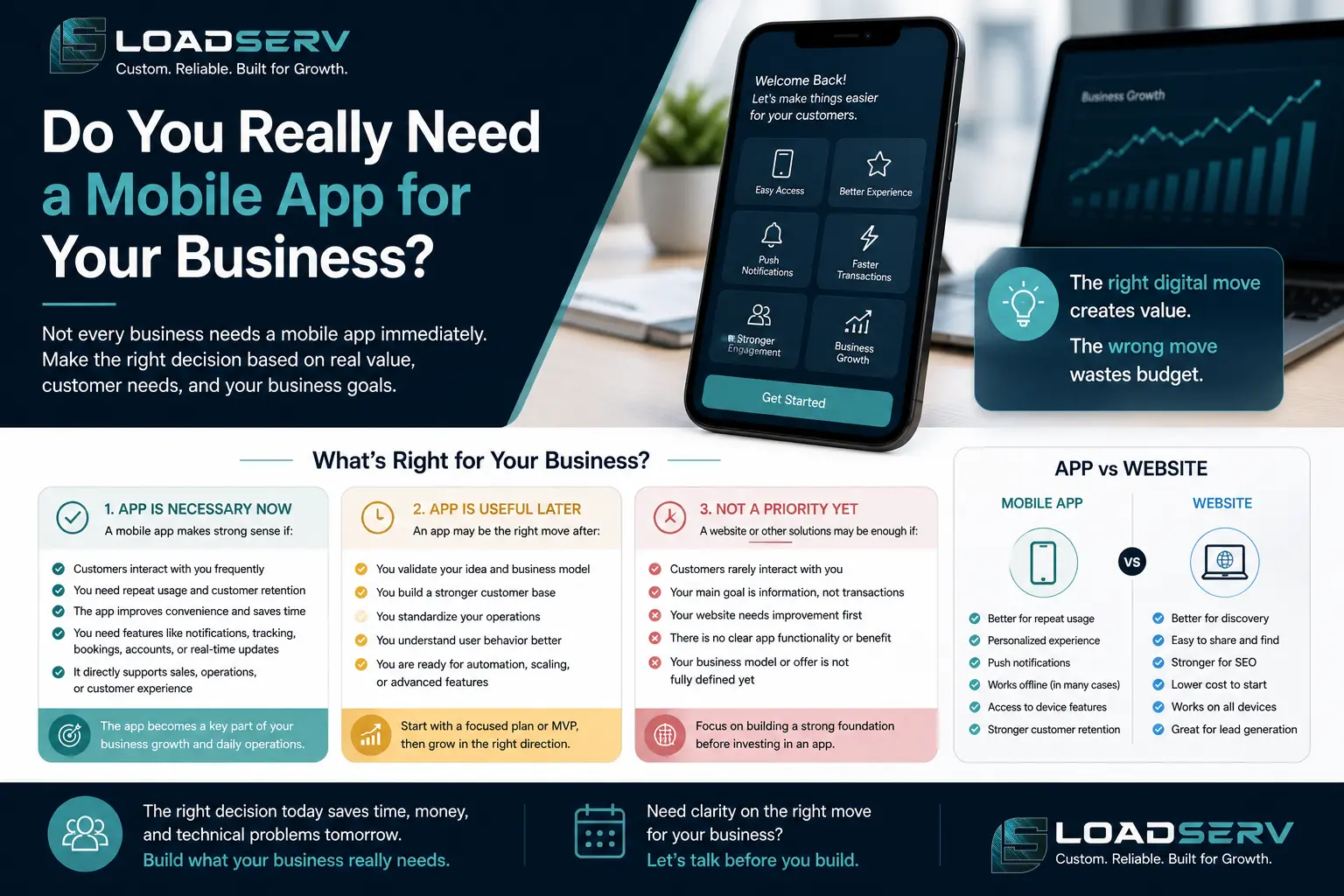
A mobile app becomes a strong option when your business depends on frequent interaction with customers or users. If people need to return often, check updates, place orders, book services, track progress, receive notifications, manage profiles, or interact with your business repeatedly, an app can create real value.
Apps are especially useful when convenience matters. A restaurant delivery service, booking platform, marketplace, educational platform, healthcare service, loyalty program, logistics system, field operation tool, or internal business workflow may benefit from a mobile app because users need quick access and smoother interaction.
A mobile app may also be justified when push notifications, offline access, device features, location, camera, QR scanning, real-time tracking, or personalized user experiences are important to the product.
In these cases, the app is not just a digital accessory. It becomes part of how the business delivers value.
A mobile app is not always the best first step. In many cases, a professional website can do the job more efficiently, especially if your main goal is to introduce the business, generate leads, explain services, publish content, receive inquiries, show a portfolio, or support search engine visibility.
If customers only need occasional interaction with your business, asking them to download an app may create more friction than value. A well-built responsive website can be easier to access, easier to share, easier to find through Google, and more suitable for early customer acquisition.
For service companies, corporate businesses, consultants, clinics, factories, agencies, and B2B companies, the website is often the stronger foundation before mobile app development.
If your current website is weak, outdated, slow, unclear, or not converting visitors properly, improving your website development may create better short-term impact than launching an app too early.
One of the clearest ways to evaluate whether your business needs a mobile app is to ask: will users have a reason to open it regularly?
If the answer is yes, an app may be useful. Repeat usage creates stronger justification for app investment because the app becomes part of the user’s routine.
If the answer is no, a website or web-based system may be enough. Many businesses do not need a place on the customer’s phone if the customer only interacts with them once every few months.
This does not mean low-frequency businesses can never need apps. But the app must provide another strong reason to exist, such as account management, support, tracking, loyalty, internal operations, or a specialized service experience.
A good mobile app should make life easier for the customer and the business. But sometimes, businesses underestimate the operational responsibility behind an app.
Once the app is launched, customers expect it to work smoothly. They expect orders to be processed, bookings to be confirmed, notifications to be accurate, support to respond, payments to succeed, and data to stay updated.
If the business does not have the internal process to support the app, the app may expose operational weaknesses instead of solving them.
Before building, ask whether your team is ready to manage the app, respond to user actions, update content, handle requests, monitor issues, and support customers after launch.
A website and a mobile app should not always be treated as competitors. In many serious digital businesses, they support different parts of the customer journey.
The website is often better for discovery, search visibility, trust building, service explanation, lead generation, and first contact. The mobile app is usually better for repeated usage, logged-in experiences, notifications, personalization, operational workflows, and deeper engagement.
For many businesses, the right sequence is website first, app later. For others, especially app-based startups or transaction-heavy platforms, the app may be the core product from day one.
The decision should follow the business model, not a fixed rule.
Your business may be ready for a mobile app if customers interact with you frequently, if mobile convenience can increase sales or retention, if your service depends on accounts or personalized experiences, or if users need notifications, tracking, booking, ordering, or real-time updates.
An app may also be justified if your current process is becoming difficult to manage manually, if you need a better operational system for your team, or if your business model itself depends on mobile-first usage.
In these cases, a custom mobile app can help create a smoother customer experience and a more controlled business process.
A mobile app may not be the right priority if your business does not yet have clear services, stable operations, a defined customer journey, or enough demand to justify app usage.
It may also be too early if your main problem is weak marketing, poor website conversion, unclear positioning, lack of content, or low customer awareness. An app will not automatically fix these problems.
If users do not have a strong reason to download and return to the app, the investment may produce limited value.
In this situation, the smarter move may be to improve your digital foundation first, validate demand, clarify the business model, or create a phased plan before moving into full app development.
Mobile app development is not only a one-time build cost. It includes planning, UI/UX design, backend development, admin dashboard, testing, deployment, updates, support, and future improvements.
After launch, mobile apps may need adjustments for new operating system versions, bug fixes, performance improvements, security updates, new features, and customer support improvements.
This does not mean you should avoid building an app. It means you should understand the responsibility clearly before starting.
You can review our pricing approach to understand how serious software cost should be evaluated based on scope, effort, quality, risk, and long-term value.
If the idea is strong but not fully clear yet, you do not need to jump directly into a large app. A focused MVP may be the right starting point.
A good MVP is not a weak product. It is the first reliable version that supports the essential user journey and allows the business to test real usage before expanding.
In some cases, the best first step may be a strategy session, prototype, clickable demo, landing page, or web-based version before committing to full mobile app development.
This is where proper technical consultation can save serious budget. Our business consulting service helps businesses evaluate app ideas, define scope, identify risks, and choose the right development path before investing heavily.
LoadServ does not believe every business should build a mobile app immediately. The right solution should serve the business stage, customer behavior, operational needs, budget, and growth plan.
Our role is to help you understand whether your business needs a mobile app now, later, or not yet. If a mobile app is the right move, we help define the proper scope, platform strategy, backend requirements, user journeys, MVP priorities, and long-term roadmap.
Through our mobile app development service, we build custom mobile apps for businesses that need reliable execution, strong planning, scalable architecture, and long-term support. We focus on building the right product, not pushing unnecessary features.
You can also explore our portfolio to see how we approach digital products across different industries, or contact LoadServ to discuss whether a mobile app is the right next step for your business.
A mobile app can be a serious growth tool, but only when it has a clear business role. It should improve access, convenience, retention, operations, customer experience, or revenue potential.
If your business needs visibility, trust, and lead generation first, a website may be the better move. If your users need repeated interaction, personalized access, notifications, tracking, or mobile-first workflows, an app may be justified.
Do not build an app only because it sounds impressive. Build it when it solves a real problem, supports a real process, and creates real value for your business and your customers.



Share your business goals with LoadServ, and we will help you evaluate whether you need a mobile app now, a stronger website first, a focused MVP, or a clearer digital strategy before development.