







This article helps founders, managers, and business owners in Egypt understand what really affects mobile app development cost, why prices vary between companies, and how to compare app development proposals based on scope, quality, complexity, backend, integrations, testing, support, and long-term business value.
One of the most common questions business owners ask before starting a mobile app project is simple: “How much does mobile app development cost in Egypt?”
The honest answer is that there is no single fixed price for a mobile app, because a mobile app is not one fixed product. A basic informational app, a booking platform, an e-commerce app, a marketplace, a delivery system, an educational app, and an internal business tool are all “mobile apps,” but they are completely different in scope, architecture, risk, effort, and long-term responsibility.
This is why app prices in Egypt can vary widely from one company to another. The issue is not always that one company is expensive and another is cheap. The real issue is usually that each company may be pricing a different level of planning, quality, technical depth, testing, support, and business responsibility.
If you want to make the right decision, do not start by asking for the cheapest number. Start by understanding what you are actually paying for.
Mobile app development cost varies because the word “app” can mean very different things. Some apps are simple digital interfaces with limited content and basic user actions. Others are full business platforms with customer accounts, admin dashboards, payments, notifications, reports, integrations, and complex backend logic.
A serious mobile app development company should not price your project as a generic package before understanding the business model, user roles, required features, operational workflows, platforms, integrations, security needs, and expected growth.
When pricing is given too quickly, it usually means one of two things: either the scope is being assumed without enough discovery, or the company is offering a generic solution that may not fully match your business.
Proper pricing starts with proper understanding. Without that, the project may look affordable at the beginning but become expensive later through delays, missing features, weak performance, rebuilds, or poor support.
Many businesses compare app prices based on the number of screens. This is understandable, but it is not accurate. Screens are only the visible part of the product. The real cost often sits behind the interface.
Behind a professional mobile app, there may be backend development, database structure, API architecture, admin dashboard, business rules, user permissions, payment flows, notifications, content management, reporting, hosting setup, testing, deployment, and post-launch support.
Two apps may have the same number of screens but completely different development costs. For example, a screen that only displays static content is very different from a screen that handles user registration, payment validation, live order tracking, booking availability, or marketplace transactions.
This is why serious app pricing should be based on functionality, complexity, risk, and operational value, not only the visual size of the app.
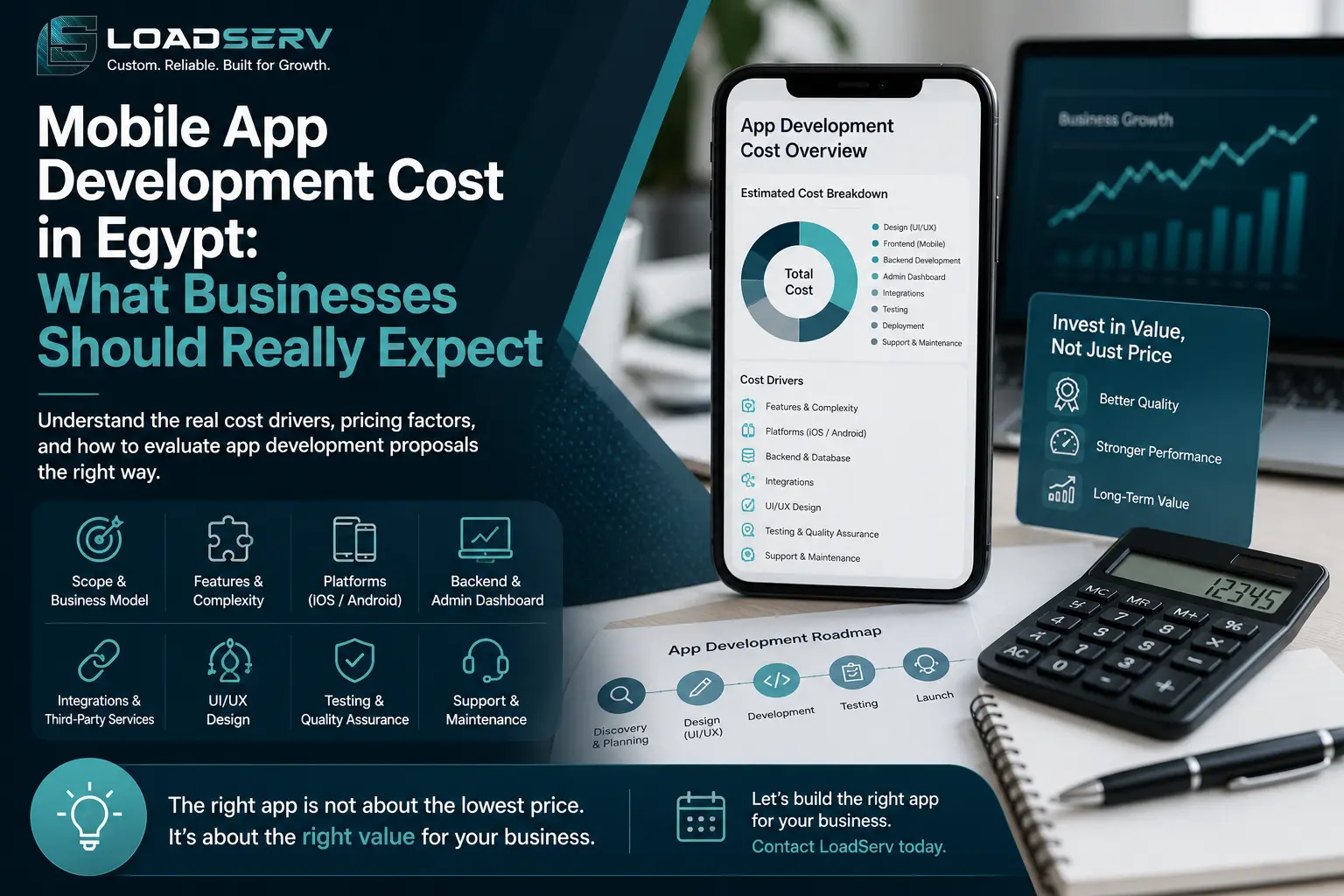
The cost of developing a mobile app depends on several connected factors. Understanding these factors helps you compare proposals more intelligently and avoid choosing an offer that looks cheaper only because important work is missing.
The first cost driver is what the app is supposed to do. A simple service presentation app is not priced like an e-commerce app. A booking app is not priced like a marketplace. A delivery app is not priced like an internal approval system.
The more the app is connected to real business operations, revenue, users, transactions, and decision-making, the more planning and development effort it requires.
Apps with one user type are usually simpler than apps with multiple roles. A customer-only app is different from an app that includes customers, vendors, drivers, service providers, branch managers, admins, or support teams.
Each user role may require different permissions, journeys, dashboards, notifications, status flows, and business rules. This affects design, backend development, testing, and project management.
Most businesses in Egypt need both Android and iOS coverage. The selected development approach affects cost. Cross-platform development using technologies such as Flutter can be efficient for many business apps because it allows one codebase to support both platforms while maintaining a strong user experience.
However, the right platform strategy should depend on the project requirements, expected users, performance needs, and future roadmap.
Good mobile app design is not only about looking modern. It is about helping users complete actions easily, reducing confusion, improving conversion, and building trust.
Apps that require custom journeys, onboarding, checkout, booking, tracking, dashboards, or complex interactions need deeper UI/UX work than apps with simple static pages.
The backend is the engine behind the app. It controls data, users, operations, transactions, permissions, content, reports, and integrations. The admin dashboard gives your team the ability to manage the system without depending on developers for every small change.
A weak backend may reduce the initial cost, but it often creates operational problems after launch. A serious mobile app should include backend planning that matches the business, not only the visible app interface.
Payment gateways, SMS providers, WhatsApp APIs, maps, delivery systems, ERP software, CRM platforms, inventory tools, analytics, and accounting systems can all affect the cost of an app.
Integrations are not simple “add-ons” when they affect business logic. They require API handling, error management, security considerations, testing, and sometimes provider-side coordination.
If your app handles users, payments, personal data, orders, bookings, or internal business information, security and performance cannot be treated as optional extras.
Better architecture, secure authentication, permission control, optimized APIs, server configuration, and scalable planning may increase development effort, but they protect the business from serious problems later.
Testing is part of the real cost of quality. A mobile app must be tested across devices, operating systems, user journeys, failed actions, edge cases, API responses, and admin operations.
Deployment also requires preparation for app stores, production environment, server setup, release configuration, and post-launch monitoring. After launch, the app may need bug fixing, updates, support, and future improvements.
To understand mobile app development cost more clearly, it helps to think in categories rather than expecting one universal price.
A simple app usually has limited functionality, fewer user roles, basic content, and minimal backend logic. It may work for businesses that only need a light digital channel or a simple customer interaction.
A custom business app usually includes real workflows, customer accounts, admin management, notifications, reports, payments, bookings, content control, or integration with business operations. This type of app requires deeper planning and more careful development because it directly affects how the business works.
A complex digital product may include marketplaces, multi-vendor systems, delivery management, learning platforms, fintech flows, advanced permissions, multi-branch operations, real-time features, AI modules, or heavy third-party integrations. These projects need stronger architecture, phased planning, testing discipline, and long-term technical ownership.
The mistake is comparing these categories as if they are the same product. They are not. Each one carries a different level of effort, risk, and business responsibility.
A cheap offer is attractive at the beginning, especially when several companies appear to be offering “the same app.” But in mobile app development, a very low price often means something has been removed, simplified, or ignored.
What may be missing? Proper discovery, custom UI/UX, experienced developers, backend quality, clean architecture, testing, documentation, security, project management, source code quality, deployment support, or post-launch responsibility.
The problem is that these missing parts may not appear clearly before launch. They often appear later as bugs, delays, poor performance, limited admin control, difficult updates, integration failures, or the need to rebuild parts of the system.
This does not mean the highest price is always the best. It means the cheapest price should be questioned carefully. Ask what is included, what is excluded, what is assumed, and what happens after delivery.
Comparing proposals only by the final price is one of the fastest ways to make a weak decision. A proper comparison should look at the full value behind the number.
When reviewing app development proposals, check whether each proposal clearly defines the scope, platforms, features, user roles, backend, admin dashboard, design process, integrations, hosting assumptions, testing process, timeline, payment terms, support, exclusions, and change request handling.
You should also evaluate how well the company understood your business. Did they simply list features, or did they explain the business logic behind them? Did they identify risks? Did they suggest a realistic MVP? Did they separate essential features from future phases?
A strong proposal should make the project clearer, not just cheaper. It should help you understand what will be built, how it will be delivered, what your team will control, and what level of support you can expect after launch.
You can also review our pricing approach to understand how LoadServ thinks about software cost, effort, quality, and long-term value.
When a mobile app is connected to sales, operations, customer service, bookings, orders, education, logistics, internal teams, or market expansion, it should not be treated as a small expense to minimize at any cost.
The better question is: what is the right scope that gives the business a reliable product, protects the budget, and creates room for growth?
Sometimes the right answer is a focused MVP. Sometimes it is a more complete first release. Sometimes the business idea needs technical and commercial validation before development starts.
This is where experienced consultation matters. If your app idea is still not fully defined, our business consulting service can help you clarify the right scope, priorities, risks, and development path before investing in full implementation.
LoadServ does not price mobile apps as generic packages because serious apps are not generic products. We evaluate each project based on business objectives, user journeys, technical complexity, backend requirements, integrations, quality expectations, timeline, and post-launch needs.
Our mobile app development service is built around custom solutions for businesses that need reliable execution, clear planning, scalable architecture, and long-term support. We do not position ourselves as the cheapest option. We position ourselves as the partner that helps you build the right product properly.
In many projects, we recommend starting with a focused MVP that covers the essential business flow, then expanding through future phases based on real usage and business priorities. This helps control cost without sacrificing quality or long-term flexibility.
You can explore our portfolio to see how we approach digital products across different industries, or contact LoadServ to discuss the expected cost and scope of your mobile app project.
Mobile app development cost in Egypt should not be guessed, copied from another project, or reduced to a single generic package. It should be based on what your business actually needs the app to do.
A serious app requires clear scope, strong planning, proper development, testing, deployment, and support. Ignoring these elements may reduce the starting price, but it usually increases risk.
The goal is not to build the cheapest app. The goal is to build the right app with the right level of quality, control, and long-term value.



Share your mobile app idea with LoadServ, and we will help you understand the expected scope, cost drivers, development approach, and the smartest way to build a reliable product without wasting budget.