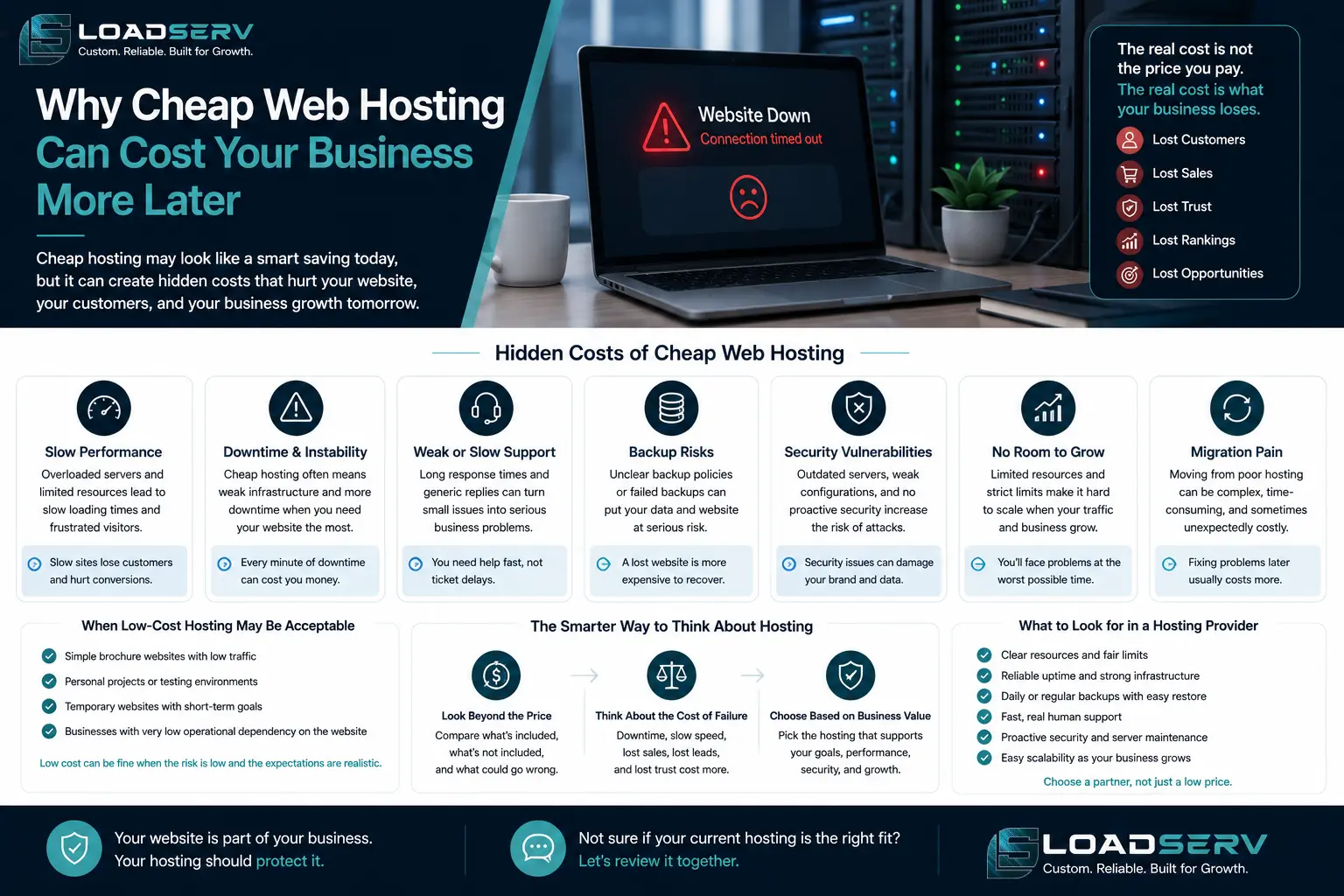








This article helps business owners, founders, and managers in Egypt compare shared hosting, VPS hosting, and dedicated servers based on cost, speed, control, reliability, scalability, technical responsibility, and business dependency before choosing the right hosting setup.
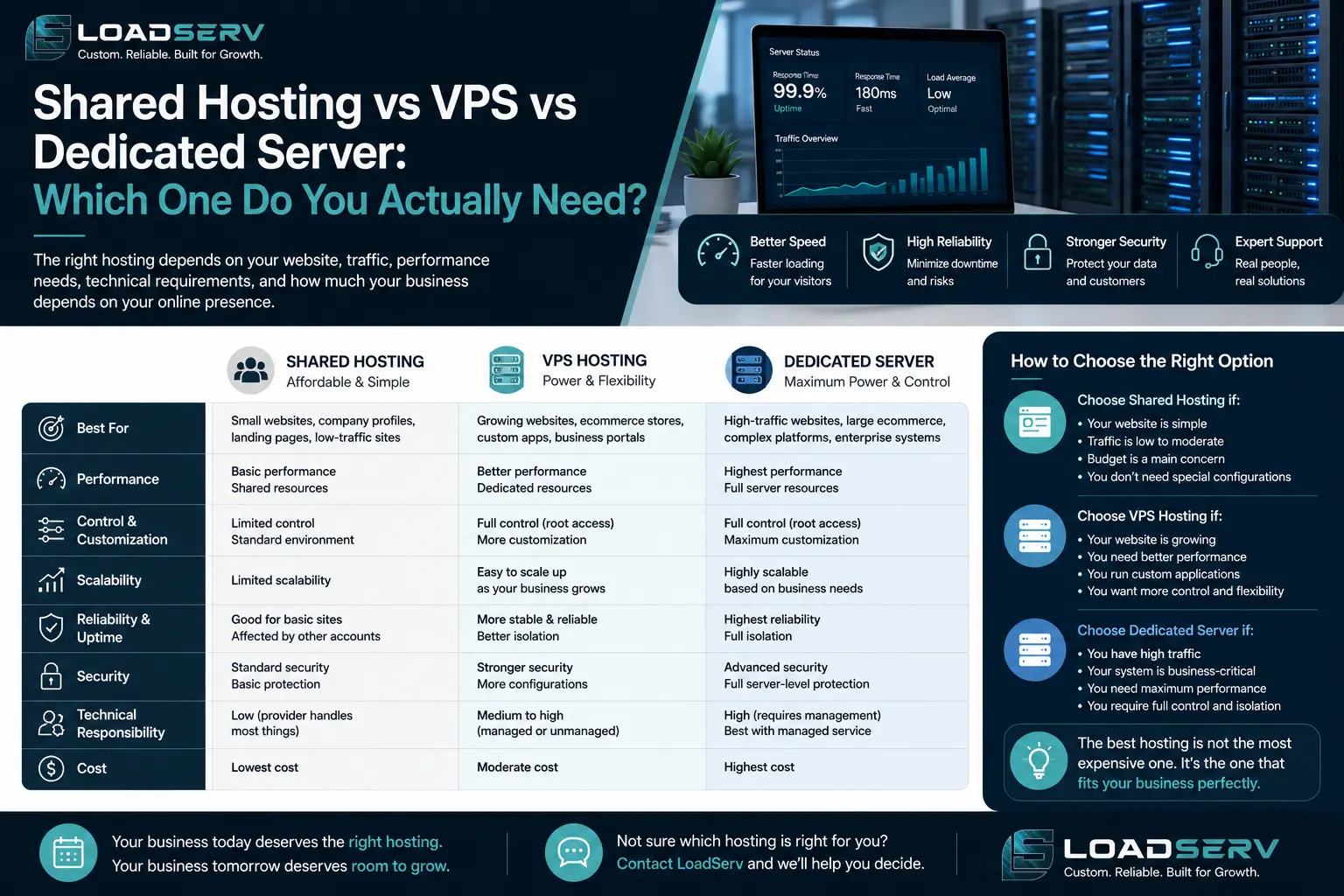
Choosing between shared hosting, VPS hosting, and a dedicated server is not about choosing the most expensive or most technical option. It is about choosing the hosting environment that fits your website, business risk, traffic level, operational needs, and growth plans.
Many businesses in Egypt start with the same question: “Which hosting is best?” But there is no single best hosting option for every business. A small company website, an ecommerce store, a custom Laravel platform, a high-traffic media website, and an internal business system do not need the same level of hosting.
The better question is: which hosting setup gives your business the right balance between cost, performance, control, reliability, and technical responsibility?
This guide compares shared hosting, VPS hosting, and dedicated servers from a practical business perspective so you can make a clear decision without getting lost in server jargon.
Before comparing hosting types, you need to understand how important the website or system is to your business. If the website is only a simple online profile, the hosting decision may be relatively straightforward. If the website generates leads, processes orders, manages users, supports customers, or runs internal operations, the decision becomes more serious.
Hosting is not only about disk space, CPU, RAM, or bandwidth. These matter, but the real business questions are different: What happens if the website becomes slow? What happens if it goes offline? How fast can someone respond? Can the system handle growth? Is the data protected? Can the hosting environment be upgraded later?
Once the website becomes connected to revenue, operations, customer experience, or business continuity, hosting should be evaluated based on risk and value, not only monthly or annual price.
Shared hosting means your website is hosted on a server that also hosts many other websites. Resources such as CPU, memory, and storage are shared between multiple accounts.
This makes shared hosting affordable and easy to start with. It is usually suitable for small business websites, company profiles, personal websites, landing pages, and low-traffic websites that do not need advanced server control.
The main advantage of shared hosting is cost efficiency. The main limitation is that your website does not have full control over the server environment, and performance may be affected by resource usage across the shared server.
Shared hosting can be the right choice when the website is simple, traffic is moderate, technical requirements are limited, and the business risk of downtime or slow performance is relatively low.
Shared hosting may become limiting when your website grows beyond basic usage. If your website starts receiving higher traffic, running heavier scripts, using complex databases, managing customer accounts, processing transactions, or depending on custom backend logic, shared hosting may not provide enough performance or control.
It can also become a problem when your business needs custom server configuration, better isolation, stronger security settings, advanced caching, background processes, scheduled jobs, API handling, or more reliable resource availability.
For a small brochure website, shared hosting may be enough. For an ecommerce store, custom platform, booking system, or business-critical website, shared hosting should be evaluated carefully before it becomes a hidden limitation.
VPS hosting gives your business a virtual private server with dedicated virtual resources. You are still using a physical server shared at the infrastructure level, but your environment is more isolated and controllable than standard shared hosting.
A VPS gives better performance potential, stronger configuration control, more flexibility, and better scalability than shared hosting. It is often a strong middle ground between basic hosting and a full dedicated server.
VPS hosting is usually suitable for growing business websites, ecommerce stores, custom web applications, Laravel platforms, customer portals, internal systems, and websites that need more reliable resources without moving directly to dedicated infrastructure.
For many businesses, VPS hosting is the practical next step when shared hosting becomes too limited but a dedicated server is not yet necessary.
VPS hosting makes sense when your website or system needs better performance, more control, stronger isolation, and a more flexible server environment.
It is especially useful when your website includes user accounts, admin dashboards, ecommerce transactions, APIs, booking flows, integrations, reporting, or custom backend logic.
A VPS also gives your technical team or hosting provider more room to optimize the environment. Caching, PHP settings, database tuning, background workers, security controls, backups, and monitoring can be handled more seriously than on basic shared hosting.
However, VPS hosting also requires more technical responsibility. If it is unmanaged, your business or technical team must handle server configuration, updates, security, monitoring, and troubleshooting. For most businesses, managed VPS hosting is usually the safer option.
A dedicated server gives your business an entire physical server. The server resources are not shared with other customers at the same server level, giving you maximum control, stronger performance capacity, and deeper infrastructure flexibility.
Dedicated servers are suitable for high-traffic websites, large ecommerce stores, complex platforms, heavy databases, enterprise systems, resource-intensive applications, and projects that need stronger isolation or advanced server configuration.
The main advantage is control and capacity. The main responsibility is management. A dedicated server must be properly configured, secured, monitored, backed up, updated, and maintained.
Dedicated hosting is powerful, but it should not be chosen for ego or prestige. It should be chosen when the business case, traffic, performance needs, security requirements, or application architecture justify it.
A dedicated server may be the right choice when your website or system is business-critical, receives significant traffic, handles heavy data processing, requires advanced isolation, or needs a highly controlled hosting environment.
It may also be appropriate when multiple websites or systems need to be hosted under one controlled infrastructure, or when the business needs specific server configurations that are difficult to achieve on shared hosting or standard VPS plans.
For larger platforms, high-volume ecommerce, internal enterprise tools, or systems that must remain stable under load, dedicated hosting can provide the control and capacity needed for long-term reliability.
But dedicated hosting only delivers value when it is managed properly. Without strong technical management, a dedicated server can become powerful but risky.
Shared hosting is usually the lowest-cost option. VPS hosting is more expensive because it offers more resources, control, and flexibility. Dedicated servers usually cost more because the business gets full server capacity and deeper control.
But hosting cost should not be compared only as a monthly or annual fee. It should be compared against business value and risk.
If a simple profile website is placed on an expensive dedicated server, the business may be overpaying. If an ecommerce store or custom platform is placed on weak shared hosting, the business may be underinvesting and exposing itself to performance problems, downtime, and lost sales.
The right hosting cost is the cost that supports the business properly without creating unnecessary waste or unacceptable risk.
You can review our pricing approach to understand how LoadServ thinks about technical cost, operational responsibility, quality, and long-term value.
Performance depends on the relationship between your website workload and the hosting environment supporting it.
Shared hosting may perform well for simple websites with limited traffic. VPS hosting usually offers better and more predictable performance for growing websites, ecommerce stores, and custom platforms. Dedicated servers offer stronger capacity for high-traffic or resource-heavy systems.
However, infrastructure alone does not guarantee performance. A poorly built website can be slow even on a strong server. A well-built website can perform efficiently on a properly selected hosting setup.
That is why hosting should be considered together with web development, database quality, caching, code structure, images, third-party scripts, and ongoing optimization.
Shared hosting gives limited control because the environment is standardized for many users. This is acceptable for simple websites, but it can restrict custom applications that need specific configurations.
VPS hosting gives more control over server settings, installed services, security configurations, performance optimization, and application requirements. Dedicated servers provide the highest level of control and customization.
The more custom your website or system is, the more important control becomes. If your project depends on special server settings, integrations, APIs, background tasks, or performance tuning, shared hosting may become too restrictive.
Control should not be chosen for its own sake. It should be chosen when it supports real business, technical, or operational requirements.
Reliability is not only about the hosting type. It is also about monitoring, backups, security, server management, response time, and the team responsible for the environment.
Shared hosting may be reliable for simple websites, but it gives less isolation and less control. VPS hosting offers better isolation and more management options. Dedicated servers offer strong control, but they also require serious technical responsibility.
Businesses should ask practical questions before choosing: Who monitors the server? How are backups handled? What happens if traffic increases suddenly? Who responds if the website goes down? How fast can the environment be restored? What security practices are in place?
A reliable hosting setup is not only a server. It is a managed environment with clear responsibility.
Scalability means your hosting can grow with your business without forcing unnecessary disruption.
A small website may start on shared hosting, then move to VPS as traffic and technical needs grow. A growing ecommerce store may start on a managed VPS, then move to a dedicated server or more advanced infrastructure when traffic, transactions, or operational dependency increase.
The goal is not to buy the biggest server from day one. The goal is to choose a hosting path that matches today’s needs while leaving room for tomorrow’s growth.
A good hosting partner should help you avoid both extremes: weak hosting that breaks under pressure, and oversized infrastructure that wastes budget before the business needs it.
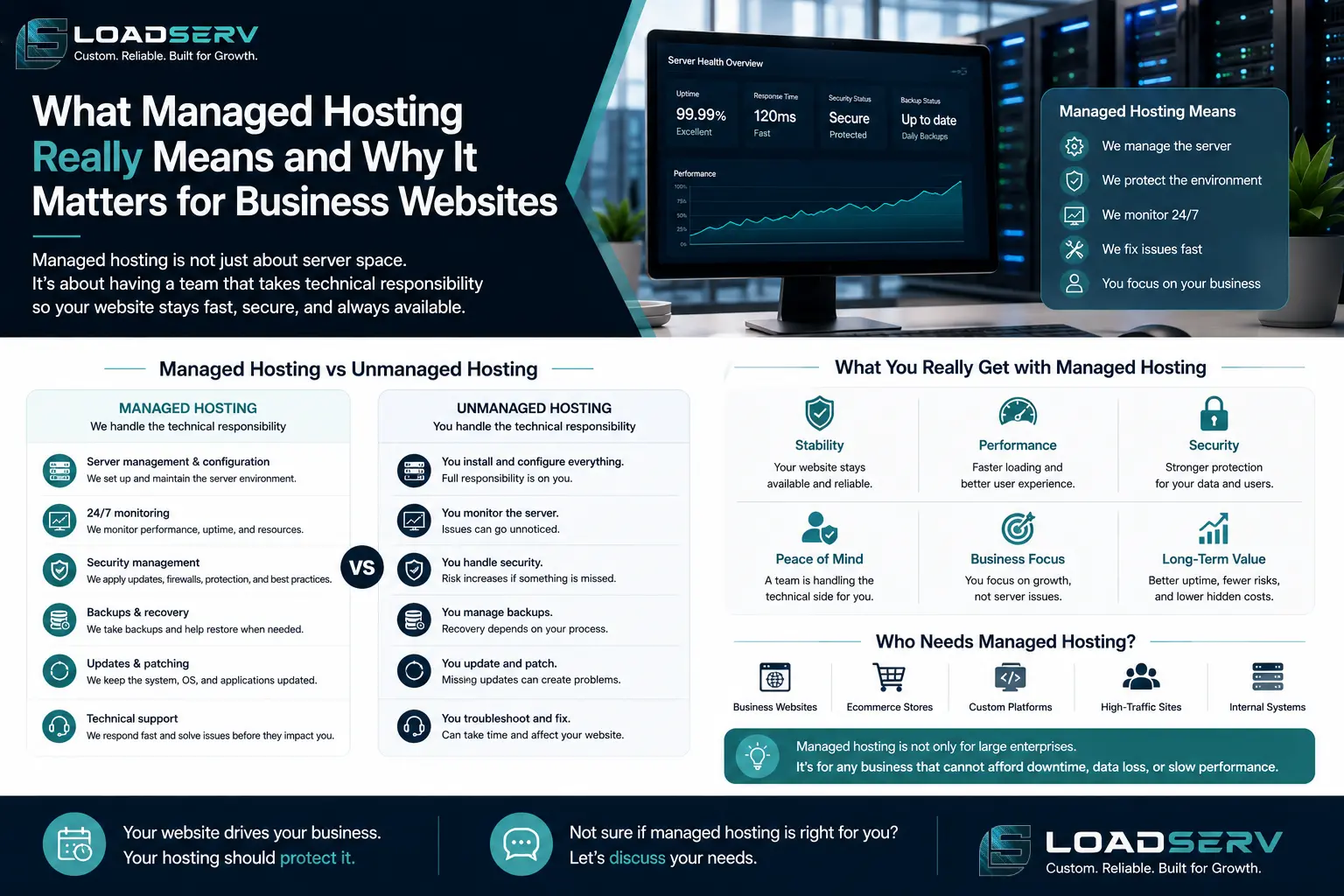
The hosting type is only one part of the decision. The second part is who is responsible for managing the environment.
With unmanaged hosting, the provider may give you server access, but configuration, security, updates, backups, monitoring, and troubleshooting are your responsibility. This can work for companies with strong internal technical teams.
With managed hosting, the provider helps manage the technical environment, monitor performance, handle configurations, apply security practices, support issues, and reduce operational risk.
For many businesses in Egypt, managed hosting is the safer choice because they do not want to turn server management into an internal burden. They need a hosting partner who can keep the environment stable while they focus on running the business.
Shared hosting may be suitable if you have a simple website, limited traffic, standard requirements, and low operational risk. It is a practical starting point for company profiles, landing pages, and small websites that need reliable but basic hosting.
VPS hosting may be the better choice if your website is growing, your ecommerce store needs more stability, your platform has users and backend logic, or your project needs better performance, control, and scalability.
A dedicated server may be justified if your website or system is business-critical, high-traffic, resource-heavy, security-sensitive, or requires strong infrastructure control.
The right option depends on website type, business dependency, traffic, performance expectations, security needs, technical requirements, and growth plans. It should not be chosen based on buzzwords or price alone.
LoadServ approaches hosting as a business decision, not only a server specification discussion. We look at what your website or system actually does, how much your business depends on it, what risks need to be reduced, and how the hosting setup should support growth.
Through our web hosting service, we help businesses choose and manage suitable hosting environments, including shared hosting, VPS hosting, dedicated hosting, and managed hosting setups based on real needs.
Our role is not to push the most expensive infrastructure. It is to recommend the hosting environment that gives your business the right balance of performance, reliability, security, support, and long-term value.
If your project is still being planned, our business consulting service can also help you define the right technical direction before choosing an environment that may be too weak, too expensive, or difficult to scale later.
Shared hosting, VPS hosting, and dedicated servers all have a place. None of them is automatically the best choice for every business.
The real decision depends on what your website does, how much traffic it receives, how much control it needs, how much downtime would cost, and how much technical responsibility your business can handle.
If your website is simple, shared hosting may be enough. If your business is growing, VPS hosting may be the smarter move. If your system is critical, high-traffic, or technically demanding, dedicated hosting may be justified.
If you are not sure which option fits your business, contact LoadServ and we will help you choose based on real business and technical needs, not guesswork.



Share your website type, traffic expectations, technical requirements, and growth plans with LoadServ, and we will help you choose a hosting environment that balances cost, performance, reliability, security, and long-term value.